
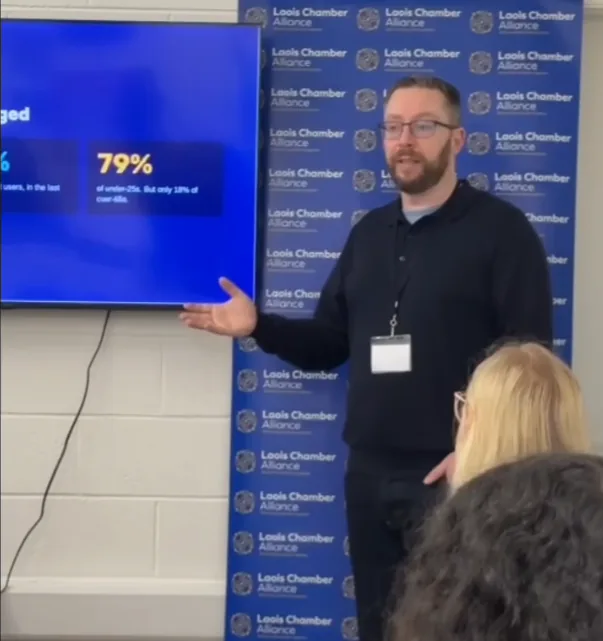
On Tuesday 29 September 2026 John Finnegan ran a workshop for Laois Chamber Alliance in Portlaoise with Alastair Roe of VIMAR Digital Marketing on what AI search has and has not changed for a local business. This article is the written version of the key points.
AI is a second front door, not a new one
You may have read that everyone has abandoned Google for ChatGPT. In Ireland, Google still handles 94% of all search (StatCounter Ireland, July 2026), and the map box that shows local businesses has not gone anywhere.
What has changed is how many people now use AI tools at all. Ofcom found that 54% of UK adults use them, in a survey of 7,533 adults between September and November 2025. Closer to home, the CSO reported on 5 December 2025 that 42% of Irish internet users aged 16 and over had used generative AI in the previous three months. That is general AI use, not local business search.
So a second front door has opened beside the first. For most local purchases, AI is a shortlisting step rather than a decision step: someone asks an assistant who might do the job, then checks those names on Google, on your website and in your reviews before they ring anyone. You are not trying to replace Google.
Whether it matters depends on your customers
AI use is far higher among younger adults than among people over 65. A wedding photographer with customers in their twenties and a boiler-servicing firm with mostly retired customers are in very different positions.
Ask what question was actually asked
Nobody has measured how people in Ireland use AI to find a local business. Most figures quoted are American, and some of the most repeated ones compare two different survey questions, asked a year apart, and present the gap as growth. When someone quotes you a number, ask what question was actually asked. If they cannot tell you, treat the number as decoration.
The phrasing decides what Google shows
On 24 September 2026 we tested two searches on google.ie from Portlaoise. "Best plumber in Portlaoise" returned the familiar map box with three local businesses and no AI answer. "How much does a plumber cost per hour in Ireland" returned an AI answer citing six sources. The same pattern held for "best restaurants in Portlaoise" and "emergency electrician near me".
Same trade, same county, two ways of asking. Searches with local intent still get the map. Informational questions get an AI answer that quotes other pages and cites them as sources.
Your profile and your website do different jobs
In Whitespark's 2026 survey, where 47 local search practitioners scored 187 factors, your Google Business Profile scored 32% for the map results against 15% for the website, and your website scored 33% for the ordinary links underneath against 7% for the profile. That is expert opinion, not a measurement of Google. The profile decides whether you appear in the map box. The website decides whether you appear underneath it. Which one is letting you down depends on where you are not showing up.
What actually moves a Business Profile
The same survey ranks the twenty things practitioners believe matter most. Only four of those twenty are confirmed by Google in writing: your primary category, your distance from the person searching, your star rating, and the number of written reviews. The rest is the opinion of experienced people. That does not make it wrong, but know which is which before you pay for it.
One item needs a warning. Adding extra keywords to your business name is widely believed to help, and the trade rates it highly, but keywords stuffed into the business name can get your profile suspended.
So when someone says a tactic will lift your rankings, ask two questions. Who says so? And did anyone test it?
Reply to reviews anyway
Replying to reviews came 122nd of the 187 factors in that survey. Do it anyway, because the reply is not really for the reviewer. They already had the experience. The person reading is the next customer, still deciding whether to ring you, so write to them.
BrightLocal's February 2026 survey of 1,002 US adults found that 80% are more likely to use a business that replies to reviews, 42% will not use one that never replies, and 50% are put off by generic, templated replies. That is American data, but the point about templates travels. The same thank-you sent to everyone reads as nobody listening.
If you do one thing after reading this, open Search Console
Google Search Console is free, takes about ten minutes to set up, and shows the searches your site already appears for. Very few business owners we meet have ever opened it.
Find the searches where you are shown but nobody clicks
On 24 September 2026, Search Console for our own site, brandstart.ie, showed 2,263 people had been shown the site for one search in the previous month. Not one clicked. That is not a ranking problem. Google is already showing the page; something about what people see is not worth the click.
- Go to Performance, then Search results, and open the Queries tab.
- Sort by Impressions and look for rows with plenty of impressions and few or no clicks.
- Open the page that appears for each one and ask whether its title and opening lines answer what that person typed.
Use the regex filter
In the same report, add a filter, choose Query, then Custom (regex). Three are worth saving:
^(who|what|why|when|where|how|which|can|do|does|is|are|should|will)\bshows the questions you already appear for, often for pages that do not exist yet.^(\w+\s){6,}shows searches of seven words or more: conversational, AI-shaped searching.\b(near me|laois|portlaoise|kildare|offaly)\bshows which local terms actually bring impressions. Swap in your own towns.
A list of questions is not a content plan. Keep the ones that would bring a buyer, and improve a page that half answers it before writing a new one.
See your AI impressions
Since August 2026, Search Console has shown how often your site appeared in AI Overviews and AI Mode, under Performance, then Generative AI, by page, country, device and date. It shows no clicks, no click-through rate, no position and no queries. You learn that you are being shown, and on which pages, but not what anyone asked.
There is no separate AI SEO
Almost everything that makes you visible to AI also makes you visible in Google. A page no crawler can reach cannot be cited by anything, and a page that says nothing specific gives an AI nothing to repeat.
Be specific or be unquotable
"We pride ourselves on a professional, friendly service." "No job too big or too small." "Competitive rates, free quotations." Between them, those lines contain no fact anyone could quote back to a customer. Compare a few illustrative lines that do: "Laois, Kildare and Offaly. Callout within two hours. Rewires from €950." "Sole trader returns from €350. Ten working days." "Open to 8 on Thursdays. Free parking at the rear."
Put facts like these in the visible words of the page: the opening paragraph, the body copy, the answers to common questions. Not only in the page title, which has room for little more than the service and the county, and not only in schema markup, which labels what the page says rather than replacing it. If every job is different, give a range or a starting price. "From €350" is a fact. "Competitive" is not.
It may not be your page that gets quoted
AI tools often cite directories rather than the business itself. In a BrightLocal study of 800 manual local searches across 20 sectors, 62% of ChatGPT's sources for "best electrician" were directories, not business websites. That was measured for a trade only, but the lesson holds: listings you have never claimed are doing work you are not controlling.
Claim the core ones: your Google Business Profile, your Facebook page, Golden Pages on the free tier, and your chamber's member listing. Then add one for your sector, such as Tripadvisor for hospitality, Houzz.ie for home improvement, or your professional body. Finally, search your own business name and check what existing listings say about you. A tradesperson may find a site has listed them without asking.
Two checks to run tonight
Ask an AI assistant about yourself. Type "What services does [your business] in [your town] offer?" into ChatGPT, Gemini or whichever assistant you use. Whatever comes back is roughly what a customer is being told. Do this one first.
Read your robots file. Go to yourdomain.ie/robots.txt and look for a line that says Disallow followed by a single slash and nothing else. That one line tells crawlers to stay out of the whole site. A Disallow line with nothing after it allows everything, and blocking /wp-admin/ is normal.
Three questions for whoever built your site
- Is every page I care about two or three clicks from the homepage?
- Is anything on this site accidentally blocked from being indexed?
- How fast does the main content appear on a phone?
On the second, WordPress has a setting under Settings, then Reading, that asks search engines not to index the site. It gets ticked during a build and forgotten. A Google search for site:yourdomain.ie takes thirty seconds. Any developer worth having answers all three without hedging.
Four pitches to walk away from
- "We will get you ranked in ChatGPT." There is no ranking to buy. Ask the same question twice and you can get two different answers.
- "Your Domain Authority is too low." That score was made up by an SEO software company. It is not a Google metric, and raising it is not a goal.
- "We will list you on 200 directories." A handful of accurate listings on sites people use beats hundreds of pages nobody visits.
- "Schema markup will lift your rankings." It will not. Structured data makes a page eligible for certain displays, such as price and stock in product results. Useful for a shop, but not a ranking boost.
Ranking well is not the same as being right. To check a claim yourself, Google publishes its guidance at developers.google.com/search and its recent changes at status.search.google.com.
What a good SEO person does instead
- They ask for Search Console access before they quote.
- They talk about enquiries, not rankings.
- They can tell you what they would do in month one.
- They do not guarantee positions.
Want someone to work through these checks with you? Our SEO for Laois businesses starts with your Business Profile, your listings and your own Search Console data, and our wider SEO service does the same for businesses anywhere in Ireland.
If the website itself is the weak link, it is easier to build it right than to patch it later. Our web design for Laois businesses puts specific facts, sensible page structure and mobile speed in place from the start, so the site is built to be found.